No one feels their bones getting weaker. That’s the problem.
Osteoporosis is often called a silent disease because bone loss occurs gradually, without any symptoms, until a fracture or a bad fall makes a noise. And ladies, it starts earlier than you think: bone density usually begins to decline in our 30s, and women can lose up to 20% of their bone mass in five to seven years during menopause as estrogen declines.
I just released a new Bone Building Strength program on Get Healthy U TV, and our members love it. So today I want to give you the why behind it: what actually builds bone, the two types of exercise that do it best, and a free workout to get you started this week.
As a 60-year-old trainer who is 10 years post-menopausal, this topic is not theoretical for me. This is my skeleton we are talking about again.
Your Bones Live (and Listen)
We treat our bones like a scaffold: they only appear when something breaks. But the skeleton is not a rigid frame. Living tissue breaks down and rebuilds itself throughout the day, a beneficial cycle scientists call remodeling.
And here’s my favorite part: like muscle, bone adapts to the stress you put on it. Power is the language your bones understand. Give them regular, challenging pressure and they respond with resilience and resilience. Give them nothing, and they quietly lose density year after year.
Read this twice: your bones need stress to stay strong. Comfort is not their friend.
This is the same reason building muscle after menopause is so important. Muscles and bones are a team, and they are strong together.
2 Best Ways to Build Bone Mass
It’s a lot of noise out there, so let me make it simple. Two types of exercise build bones better than anything else:
- Lifting weights, focusing on the eccentric (lowering) phase.
- To jump
That’s the list, and that’s why each one works.
1. Lifting Weights (Heavier Than You Think)
When you strength train, your muscles pull on your bones through their attachments, and that tension under load is a direct signal to your body: build more bone here. Research is clear that the load itself is the most important, so compound movements like squats, deadlifts, and overhead presses with constant weight are the gold standard for your skeleton.
The eccentric part of each rep (the lowering phase) is the biggest part of that signal. Think of the way down into a squat, or lowering a dumbbell back from a biceps curl. Your muscle expands while under tension, allowing you to handle large forces with control, and controlled forces are what tell your bone cells to activate.
So apply it to real life: don’t get into your downs, handle it. Take a controlled count of 3 down into your squat, then stand up straight. Lower that pressure up as you say. Your muscles will feel it (hello sore glutes), and so will your skeleton.
If you’re new to lifting or returning to it, start with these strength exercises to prevent menopausal muscle loss. Start where you are. Your bones don’t need you to develop, they need you to adapt.
2. Jumping (Yes, You’re Allowed)
Your muscles get stronger when you load them. Your bones get stronger when you hit the ground. Jumping, jumping, and plyometric movements send controlled force through your skeleton, and that impact triggers your body’s natural response to build bones (your hips respond very well to it).
I know what some of you are thinking: “Chris, I’m 55, I don’t jump anymore.” I will lovingly defer to that. Unless you have a medical reason not to (more on that below), midlife is exactly where you should keep jumping, because it’s the skill and motivation you lose when you stop using it.
You don’t need to jump into the box. Small hops in the area, a few jump squats, and even quick stair climbing counts as an impact to use for your bones. Warm up first (these warm-up tips for middle-aged women are perfect), sit slowly with bent knees, and build slowly.
The Combo Is Where The Magic Happens
You don’t have to choose between lifting and jumping, and you shouldn’t, because studies of menopausal women show a combination of beats or just one.
That’s how I built my new one Bone Building Power #1 workout on Getty U TV: strength training with jumping jacks. You lift with a slow, eccentric controlled lowering, then add short bursts of impact between power movements. Your bones get both signals (intensity and impact) in one effective workout, and honestly, it’s a blast. Our members have already told me that they feel stronger and more powerful.
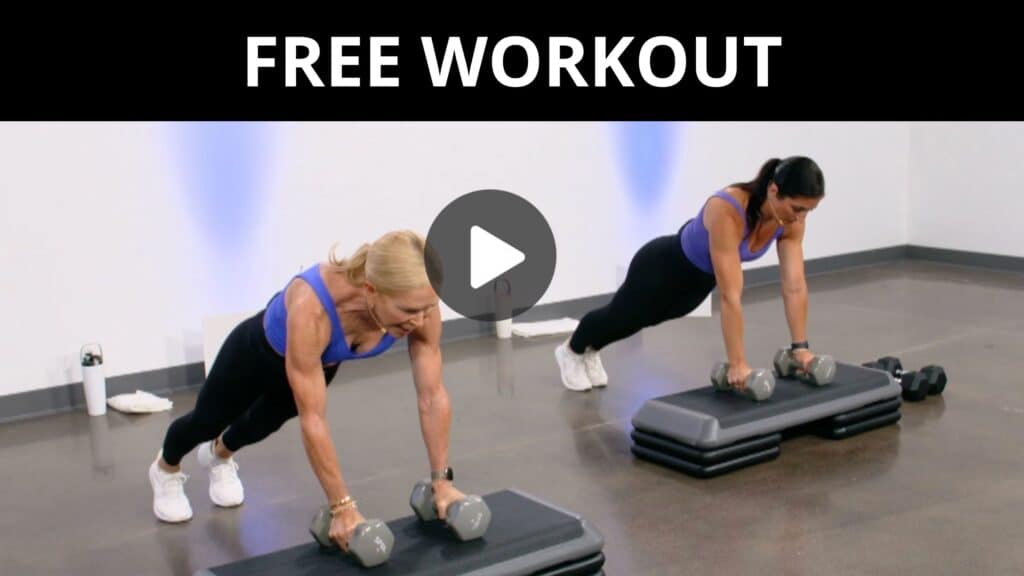
Want to try it for free? Open a free bone-building workout here and do it with me this week!
A Quick Word About Safety
Most women benefit from bone-strengthening exercise, but if you’ve been diagnosed with low bone density or osteoporosis, have had a recent fracture, or have balance problems, talk to your health care provider before adding high-impact activity. A physical therapist can help you find safe, modified exercises for osteoporosis.
And if you don’t know your baseline, ask your doctor about a DEXA scan. A routine bone density test is quick and painless, and is usually recommended at age 65 (earlier if you have risk factors such as family history, smoking, low body weight, or long-term steroid use). You can’t manage what you haven’t measured.
Nourish Your Bones Too
Exercise sends a signal to build, but nutrition provides raw materials. Women over 50 need about 1,200 mg of calcium per day, and vitamin D to really absorb it: milk, leafy greens, fatty fish like salmon, eggs, nuts, and beans all weigh in. Magnesium and vitamin K support labor as well.
And don’t sleep on protein. It builds bone and muscle, so don’t stop at it. Not sure how much you need?
Use my free protein calculator to find your daily target.
One more thing, because I’ll always say it out loud: estrogen plays a major role in bone strength, which is why bone loss accelerates after menopause. It is another reason why Dr. Mary Claire Haver The New Menopause it’s on my required reading list. HRT is not right for everyone, so talk to your doctor about whether it makes sense for you.

How Long Does This Take?
Building bone is a long game. With consistent strength training, impact work, and a good diet, changes usually take a year or more to show up on scans, which is why doctors usually retest bone density every one to two years. That may sound slow, but remember: you’re reversing a process that took years, and each workout is a deposit into the account.
Aim for strength training 2 to 3 times a week at least, sprinkle in some impact work, keep up your daily weight-bearing movements like walking, and build in recovery days (your bones are remodeled during rest, too!).
The sooner you start, the better, and it’s never too late to start. I’ve watched women in their 60s and 70s get stronger in a measured way. Your bones obey at all ages. Pay attention to these six early warning signs of osteoporosis to stay alert.
The moral of the story? Lift heavy, lower slowly, jump lightly, eat your protein, and repeat for a long, strong life. Your skeleton does its best work quietly behind the scenes, so give it something to work with.
Are you ready to start? Grab my free Bone Building Strength workout and build bone together.
PS. Cardio is to live longer, strength training is to live stronger, and training to walk is to live without pain. Bone formation is the reason it is “strong” to make the list.
Bone Density FAQs
Osteopenia means that your bone density is lower than normal, which is the first stage of bone loss that can progress if left untreated. Osteoporosis is a stage of the disease: bones become brittle and break, usually in the hips, spine, and wrists. Osteopenia is a warning light; Osteoporosis is a breakdown.
In the 30s, bone loss accelerates after menopause due to a decrease in estrogen. Because there are often no symptoms, starting the preventive power and the impact of early news training.
Schedule a year or so of consistent training before changes show up on a bone density scan (doctors usually retest every one to two years). Age, nutrition, hormones, and exercise intensity all affect the timeline.
Anyone diagnosed with low bone mass, severe osteoporosis, a recent fracture, balance problems, or a medical condition that raises the risk of injury should be evaluated by a health care provider first. A physical therapist can prescribe osteoporosis-specific exercises.
Foods rich in calcium, vitamin D, protein, magnesium, and vitamin K: milk, green vegetables, fatty fish, eggs, nuts, beans, and fortified foods such as milk and orange juice.
At least 2 to 3 times a week, with built-in recovery days. Consistency over months is what moves the needle, not any single championship workout.