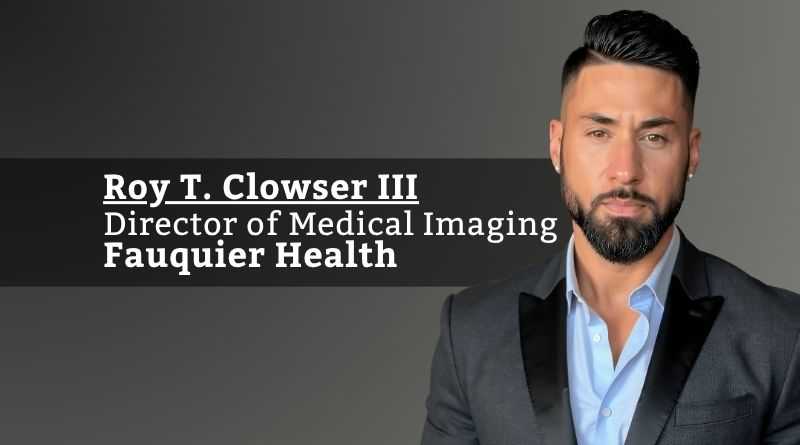
By Roy T. Clowser III, Director of Medical Imaging, Fauquier Health
In healthcare, there is perhaps no more complex balancing act than aligning priorities across radiology, IT, finance, and operations. Each group has an important sense of purpose, usually based on valid limits, data, and accountability. On the outside, these ideas can sound rigid—strong positions that block progress and create conflict. However, what I have learned from experience is that these parties are not enemies. They are human beings, operating within systems that shape their motivations, fears, and definitions of success. The moment we reorganize this communication from hierarchy to human interaction, alignment not only occurs but is sustained.
Radiology, commonly known as medical imaging in today’s environment, is driven by quality, speed, and patient safety. IT is responsible for the security, integration, and stability of the system. Funds focus on income, financial management, and long-term sustainability. The practice has a mission of excellence, patient experience, and efficiency. Each of these priorities is justified, but when considered in isolation, it can seem inconsistent. This is where agency conflicts arise—not because individuals are difficult, but because each role is designed to achieve a different outcome. The tension we hear in these conversations is not dysfunction; it is a natural product of a system that relies on specialized knowledge.
A mistake we often make as leaders is to think that alignment comes from stronger arguments or more data. We double down on our vision, armed with metrics and logic, believing that clarity will drive consistency. In fact, this approach can increase division. When people hear that their domain expertise is being challenged or dismissed, they become more focused. What appears to be insensitivity is often a protective nature. People are protecting not just a position, but their professional identity and accountability. Realizing this is the first step in humanizing the conversation.
The most successful outcomes are not those where one participant ‘wins,’ but those where each party sees what is most important to them is reflected in the final decision.
True alignment begins with recognizing each stakeholder’s lens. Before we ask someone to bend, we must show that we understand where they cannot. In radiology, that could be diagnostic quality and patient safety. In IT, there may be risks to cybersecurity and system integrity. In finance, it is financial responsibility and return on investment (ROI). In activities, access and flow. When these non-negotiables are clearly defined and respected, the conversation changes. We no longer argue about who is right; we jointly define the boundaries within which understanding must occur.
From there, the job becomes to identify where the flexibility exists. This is where important conversations begin. These are not purely decision-oriented meetings, but deliberate discussions designed to reveal priorities, obstacles, and opportunities. It requires leaders to ask better questions: Where can we face each other without jeopardizing our core responsibilities? What trade-offs are we willing to consider? What does success look like for each participant, and where do those definitions fit? These conversations are not free, but they are necessary to move from conflict to unity.
Communication style plays an important role in whether these conversations are successful. Data is always important, but it must be paired with empathy and clarity of purpose. Participants must understand not only what is being proposed, but why it is important to more than one department. Organizing decisions around shared outcomes—patient care, organizational sustainability, and team effectiveness—creates common ground. When people see how their contribution fits into a greater purpose, they are more willing to engage in compromise. Alignment is rarely about winning; it’s about advancing something bigger than any single activity.
Trust is the money that makes this process work. Without it, even well-constructed conversations will not succeed. Trust is built through consistency, transparency, and follow-through. When leaders demonstrate that they will represent all stakeholders—not just their own background—they create an environment where people feel safe to freely interact. This does not eliminate conflict, but changes its nature. Conflict is productive rather than personal, focused on solving problems rather than defending positions.
Ultimately, the act of balancing across radiology, IT, finance, and operations is not a technical challenge—it’s a human one. Systems, budgets, and workflows are all critical, but they are shaped and executed by people. When we limit participants in their activities, we limit our ability to communicate and collaborate. When we see them as people navigating complex tasks, we unlock the potential for true alignment. The role of leadership in this space is not to defuse tension, but to guide it toward meaningful outcomes through communication, empathy, and shared purpose.
In my experience, the most successful outcomes are not those where one of the participants “wins,” but those where each party sees what is most important to them and is reflected in the final decision. It is in these moments that mutual understanding becomes more than a temporary agreement—it becomes the basis for future cooperation. The next challenge is experiencing less resistance, more openness, and a stronger sense of partnership. This is how organizations move forward, not by avoiding difficult conversations, but by being human and embracing complexity together.
I celebrate many wins in the field of medical thinking, blazing paths where no one dares to go. Before celebrating these success stories, I focused on having the best data, best presentations, and technical specifications. However, none of this ever sealed the deal. It wasn’t until I had other decision-makers in the seats next to me that the approvals flowed and the working relationship grew to the point where we were no longer looking at each other, but in the same direction.