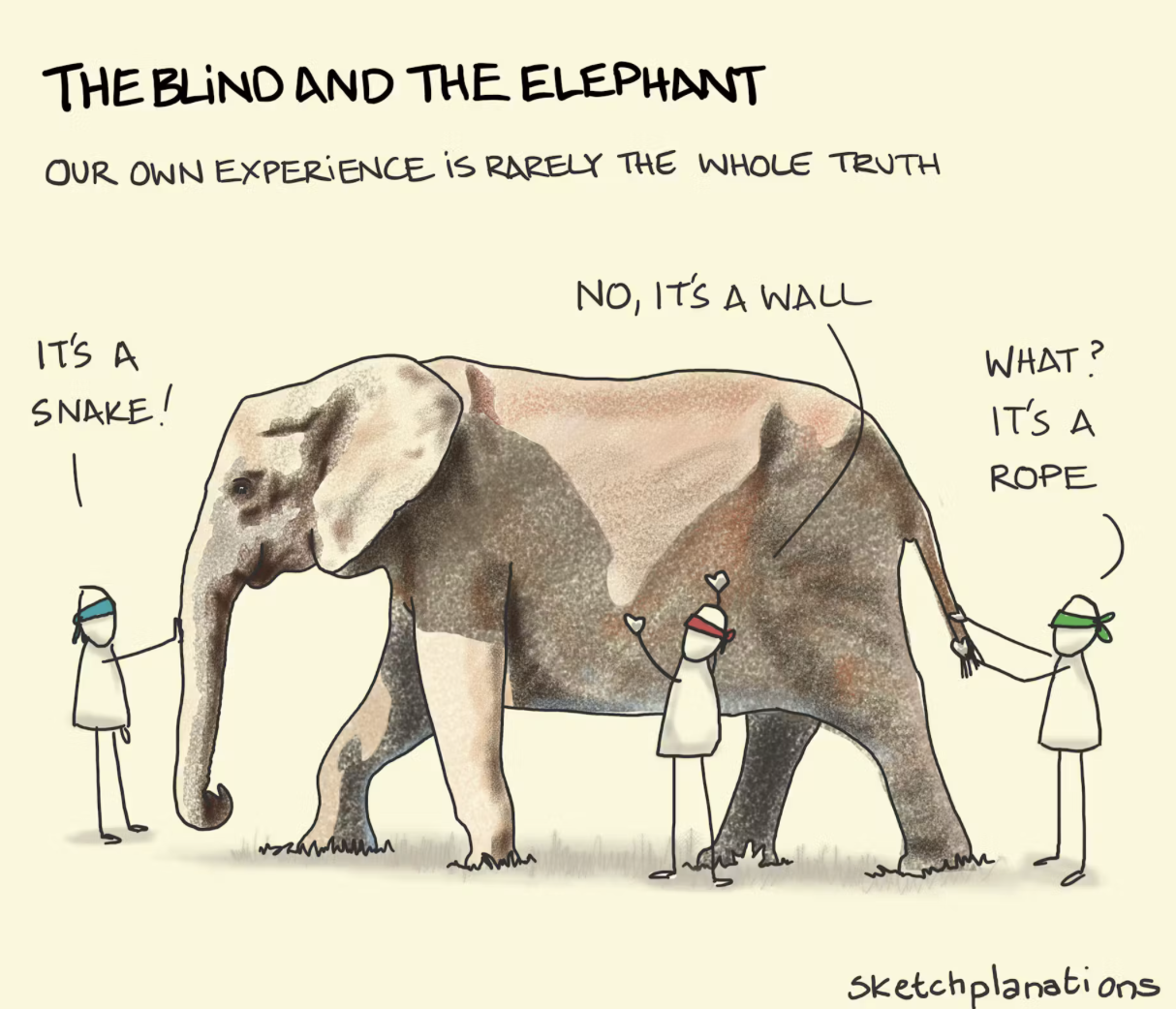
The Parable of the Blind Men and the Elephant.
A long time ago in a village in India, there lived six blind men who had never seen an elephant. One day, a report was spread that a magnificent elephant had arrived in the village. Wanting to understand what this animal was like, six blind men went to examine it. Each man touched a different part of the elephant:
- I first the man approached Ndlovu on the side and feel its wide, flat surface. “Oh!” he exclaimed, “An elephant is like a the wallfirm and immovable!”
- I the second time the man touched the it holds and felt its smooth, sharp shape. “No,” she said, “an elephant is like a a spearsharp and dangerous!”
- I the third time the man grabbed the titlewhich was swinging nicely. “You’re both wrong,” she said. “An elephant is like a a snaketall, flexible and powerful!”
- I the fourth the man wrapped his arms around one of them legs. “Obviously,” he said, “an elephant is like a medicine, it is thick, strong, and rooted in the ground.”
- I for the fifth time the man stretched out his hand and felt it eartaking a deep breath. “An elephant is like a a follower,” he announced, “wide and flat, ready for self-healing.”
- I for the sixth time the man is holding the the tail then he laughed. “You are all wrong! An elephant is like a ropethin and flexible.”
The six men began to argue loudly, each insisting that his interpretation was the only correct one. Their voices grew more and more angry until a wise man who was passing by stopped to listen.
He smiled and said:
“You are right, yet everyone is wrong. Each of you touched one part of the elephant. An elephant is much bigger and more complex than any one part. Only by putting all your ideas together can you begin to understand everything.”
Explanation
This ancient metaphor (found in Buddhist, Hindu, and Jain traditions, and later popularized in the West by John Godfrey Saxe’s 19th-century poem) illustrates several important ideas:
- An incomplete truth: People often see only a small part of the truth and mistake it for the whole.
- Perspective is important: Different opinions can be valid but not perfect.
- Humility and dialogue: Real understanding comes from listening to others and synthesizing information rather than arguing from limited experience.
- Limits of vision: What we “see” depends on where we stand (or, in this case, what we can touch).
The story is often used to teach tolerance, the importance of multiple perspectives, and the danger of absolute certainty. It is a favorite in philosophy, religion, science, and even business discussions about complex problems
A wise observer represents the solution: humility and openness to many ideas. This illustration shows how confirmation bias cuts through the truth and fuels unnecessary conflict.
Key Teachings We Can Apply In Daily Life:
Here are some very useful lessons from the example:
- Accept Privacy About Your Information
Your opinion is real and valid—but probably not always perfect. What feels like absolute truth to you (based on your experience, role, or limited data) may be just one part of a larger truth. In life, this means pausing before saying “That’s right” to conversations, decisions, or ideas. Ask yourself: “Which part of the ‘elephant’ am I touching?” - Seek and Appreciate Diverse Perspectives
The blind could better understand the elephant by listening to each other and combining what they saw. In your life, actively invite input from people with different backgrounds, expertise, or opinions—coworkers, family members, or critics. This is especially important for teamwork, problem solving, relationships, and leadership. Collaboration often reveals “everything” that no one person can see on their own. - Avoid Dogmatism and Minimize Conflict
Many unnecessary arguments, divisions, and misunderstandings arise from thinking that others are wrong (or lying) simply because their experiences differ. The parable encourages curiosity about fighting: “Tell me more about what you’re going through” instead of “You’re wrong.” This affects politics, religion, disagreements at work, and even personal relationships. - Practice Compassion and an Open Mind
Each blind man was sincere and completely infallible—his interpretation was consistent with his limited senses. Realizing this encourages empathy: others are often not cruel or stupid people; they often describe a different part of the same reality. This concept helps in discussions, counseling, teaching, and daily interactions. - Pursue the Big Picture
True wisdom involves integrating many ideas rather than sticking to one. In practice, this can mean doing extensive research before making big decisions, using data from a variety of sources, or showing how your “mental models” (as systems thinker Peter Senge calls them) may be limiting you. It also reminds us that some truths (such as complex systems, human behavior, or spiritual truths) are inherently difficult for any one person to fully understand. - Be Willing to Revise Your Understanding
If the blind people remained curious and touched other parts (or asked others to guide their hands), they could revise their ideas. In life, treat beliefs as temporary. Be open to new information that expands or corrects your first impressions.
Daily Requests
- At work: When a project stalls because departments see it differently, remember the elephant and count all the “parts” together.
- In a relationship: Rather than insisting that your opinion on the argument is the only one, examine your friend’s “elephant side.”
- In society: The parable warns against echo chambers and extreme relativism alike. It promotes dialogue and integration rather than dismissing others or claiming that there is no definitive truth at all.
- Personal growth: Always expose yourself to new experiences to “touch” life’s many elephants.
The story does not mean that all ideas are equally valid or that objective truth does not exist. It means we have to face the truth humility, curiosity, and dedication to seeing more. By internalizing this, we argue less foolishly, understand more deeply, and make wise decisions.